Ultrasound for Research · Channel RF data

Raw channel RF data and programmable ultrasound acquisition

ArtUs USS-2H research ultrasound platform

Access raw RF data from up to 64 individual receive channels, beamformed RF data at several signal-processing stages, and programmable control of ultrasound acquisition through the TELEMED SDK and ArtUs RF Data Control II.

Channel-level research at a fraction of the cost of large research platforms.

ArtUs USS-2H research ultrasound scanner

64 TX/RX

Channel RF data

5 source points

Channel RF, beamformed RF, I+Q

Programmable

TX/RX delays, pulses, apertures

6 × I/O

Line, frame and scan sync — standard

What you can control

Beyond raw data access, ArtUs USS-2H exposes acquisition controls for experiments that go beyond conventional focused B-mode scanning.

  • 01

    Custom transmit delays for individual channels and apertures

  • 02

    Selection of active channels from the 64 available receive channels

  • 03

    Custom tri-state transmit excitation pulses (+A, 0, −A)

  • 04

    Arbitrary beams and working apertures, and custom acquisition sequences

  • 05

    Analog front-end parameters and custom depth-dependent analog gain

  • 06

    Documented configurations for plane-wave, plane-wave compound and passive reception

Transmit and RF data acquisition path

TX control determines how the acoustic event is generated. The receive path exposes five documented data source points: channel RF before beamforming and four points after the beamformer.

ArtUs USS-2H research signal pathTransmit path: TELEMED SDK and RF Data Control II set acquisition control (TX delays, excitation pulse, active aperture, beam sequence), which drives the TX electronics and the transducer. Receive path: analog front end and ADC, beamformer, bandpass filter, angle apodization and Hilbert transform. RF data can be accessed as raw channel data before beamforming and at four source points: ID 1 beamformer output, ID 2 bandpass output, ID 3 angle apodization output, ID 4 I/Q after the Hilbert transform.PROGRAMMABLE TRANSMIT PATHDefined by the researcher through the TELEMED SDKTELEMED SDKRF Data Control IIAcquisition controlTX delays per elementTX pulse: 3-level with PWMActive aperture / channelsBeam / aperture sequenceTX electronicsProgrammable excitationArtUs transducerTransmit + receiveRECEIVE / DATA PATHChannel RF and beamformed RF data access pointsEcho signalsAnalog front end + ADC64 channelsRAWChannel RF dataUp to 64 channels,before beamformingBeamformerDelay-and-sumSOURCE ID 1Beamformed RFBeamformer outputBandpass filterSOURCE ID 2Beamformed RFBandpass outputAngle apodizationSOURCE ID 3Beamformed RFAngle apodizationoutputHilbert transformI + Q outputSOURCE ID 4I + Q dataHilbert transformoutput ArtUs USS-2H research signal pathTransmit path: TELEMED SDK and RF Data Control II set acquisition control (TX delays, excitation pulse, active aperture, beam sequence), which drives the TX electronics and the transducer. Receive path: analog front end and ADC, beamformer, bandpass filter, angle apodization and Hilbert transform. RF data can be accessed as raw channel data before beamforming and at four source points: ID 1 beamformer output, ID 2 bandpass output, ID 3 angle apodization output, ID 4 I/Q after the Hilbert transform.PROGRAMMABLE TRANSMIT PATHTELEMED SDKRF Data Control IIAcquisition controlTX delays per elementTX pulse: 3-level with PWMActive aperture / channelsBeam / aperture sequenceTX electronicsProgrammable excitationArtUs transducerTransmit + receiveEcho signalsRECEIVE / DATA PATHAnalog front end+ ADC64 channelsRAWChannel RF dataUp to 64 channels,before beamformingBeamformerDelay-and-sumSOURCE ID 1Beamformed RFBeamformer outputBandpassfilterSOURCE ID 2Beamformed RFBandpass outputAngleapodizationSOURCE ID 3Beamformed RFAngle apodizationoutputHilberttransformI + Q outputSOURCE ID 4I + Q dataHilbert transformoutput
Simplified research signal path and documented data access points.
DataAccess pointPurpose
Channel RF dataRawBefore receive beamformingIndividual signals from up to 64 active receive channels.
Beamformed RF dataSource ID 1Beamformer outputRF immediately after the receive beamformer (summation) stage.
Beamformed RF dataSource ID 2Bandpass outputBeamformed RF after bandpass filtering.
Beamformed RF dataSource ID 3Angle apodization outputBeamformed RF after the angle apodization stage.
I + Q dataSource ID 4Hilbert transform outputComplex I/Q representation after the Hilbert transform stage.

Programmable ultrasound acquisition

Channel data access is only one part of the platform — you also control how the data are acquired. The corresponding SDK interfaces are demonstrated in the ArtUs RF Data Control II sample.

Plane-wave acquisition

Configure plane-wave scanning by programming identical non-zero transmit delays across the active 64-channel aperture, or vary the delays to steer the plane wave. The RF Data Control II documentation includes plane-wave compound scanning with multiple delay sets, for example:

0°−2°+2°−4°+4°

For transducers with more elements than the 64-channel electronic aperture, arbitrary beam selection lets you choose different aperture positions, their number and overlap — according to the coverage and acquisition rate you need.
Passive acoustic acquisition

In receive-only configuration every transmit delay is set to zero: transmission is muted while the receive channels remain available. This suits experiments in which the acoustic signal comes from an external source rather than the scanner.

  • Photoacoustic / optoacoustic
  • Passive cavitation detection
  • Cavitation mapping
  • HIFU / therapy monitoring

These are research use cases, not turnkey TELEMED imaging modes.

I/O synchronisation

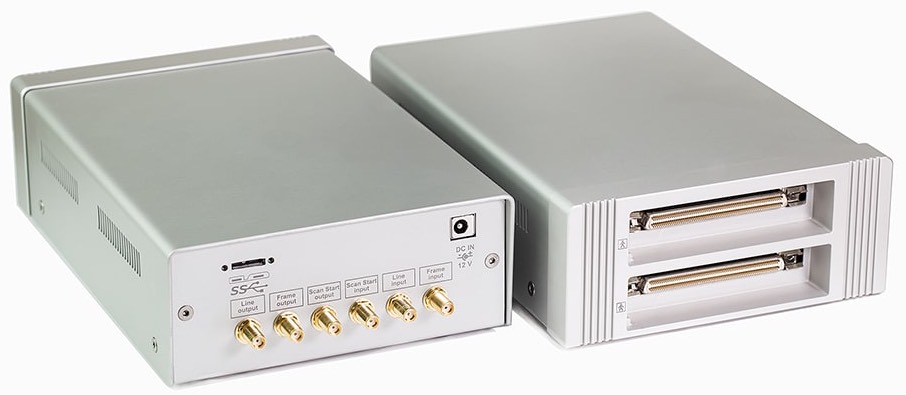
I/O synchronisation is a standard feature of ArtUs USS-2H — no additional module is required. Synchronise the scanner with external equipment such as signal generators, light sources for photoacoustic experiments, motion capture, EMG or a second scanner. Six coaxial connectors carry line, frame and scan-state signals in both directions.

Outputs

USS-2H → external device
  • Line outputfalling edge

    Marks the start of data acquisition for one ultrasound line. Stays at logic 0 at the end of the line.

  • Frame outputfalling edge

    Marks the start of data acquisition for one frame. Returns to logic 1 at the end of the frame.

  • ScanStart output

    Logic 0 in FREEZE state, logic 1 in SCAN state.

Inputs

External device → USS-2H
  • Line inputrising edge

    Starts acquisition of one ultrasound line approximately 20 µs after the edge.

  • Frame inputrising edge

    Starts acquisition of one frame approximately 20 µs after the edge. The number of frames per trigger is configurable; 0 means continuous scanning.

  • ScanStart inputrising edge

    Toggles between FREEZE and SCAN at each edge, like the Freeze button.

SMA femaleConnectors, 50 Ω coaxial cable with SMA male plug
2.5 / 3.3 V CMOSInput level, 5 V tolerant
3.3 V CMOSOutput level
ArtUs Sync OptionsUtility to configure the input modes

Why the combination matters

The research value of USS-2H is the combination of programmable transmit/receive acquisition and access to individual channel signals. Define the acquisition sequence in the scanner, then perform your own beamforming, localisation, filtering or reconstruction offline or in custom software.

Acquisition control

  • TX delays
  • TX excitation pulse
  • Active RX channels
  • Arbitrary beams / apertures
  • AFE / depth-dependent analog gain

Research scenarios

  • Custom focused / unfocused transmission
  • Plane-wave and steered plane-wave acquisition
  • Plane-wave compound sequences
  • Passive receive-only acquisition
  • Custom beamforming / reconstruction

RF Data Control II · SDK

A working tool with full source code.

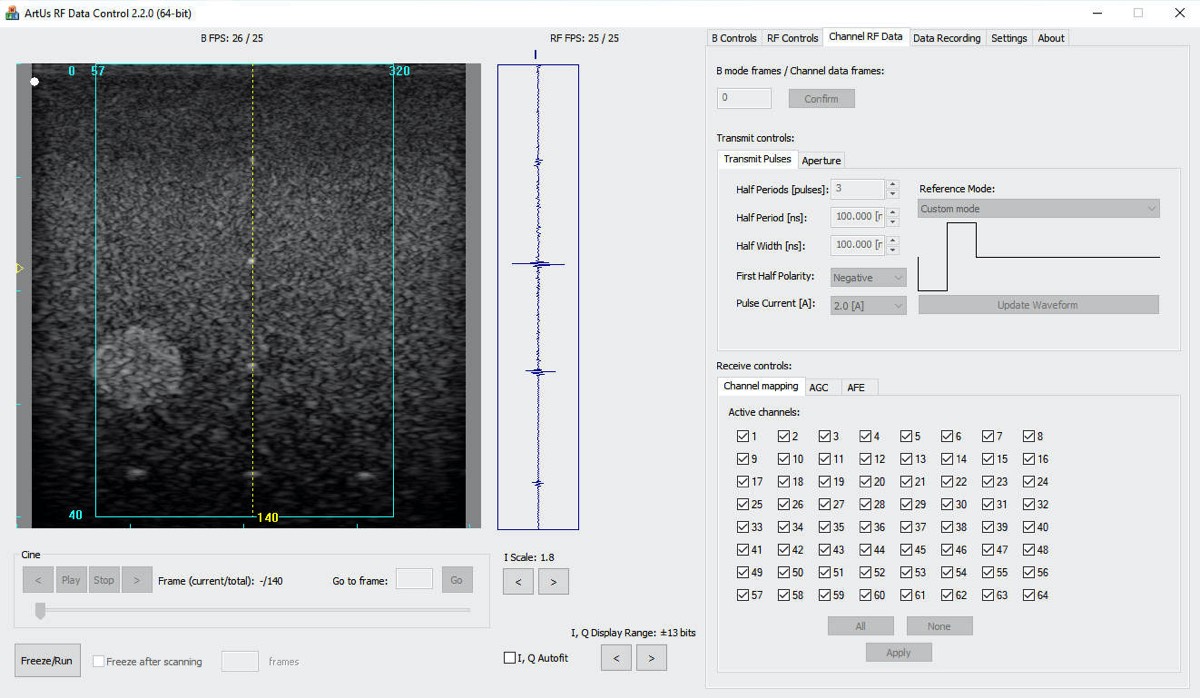
ArtUs RF Data Control II is a C++ SDK sample and reference implementation that shows how TELEMED SDK interfaces are used for channel RF data acquisition and programmable ultrasound control.

It includes a graphical user interface and source code. For many experiments it can be used directly; if you need a specialised workflow, use the same SDK interfaces and the supplied source as a reference for your own software.

ArtUs RF Data Control II graphical user interface

Start with the sample — or build your own workflow

ArtUs USS-2H combines a programmable 64-channel front end, control of transmit delays, excitation pulses and acquisition sequences, five selectable RF data source points from raw channel RF to I/Q, I/O synchronisation with external equipment and SDK-level control of acquisition.